

According to industry data, choosing the wrong type of chlorination system – domestic or industrial – accounts for 40 per cent of incidents in communal swimming pools. An undersized domestic system leads to unstable water quality, 35 per cent higher energy consumption and premature breakdowns, with a service life reduced to 60 per cent.
Quick decision:
- Residential (<150 m³): Premium domestic product with a 30 per cent margin
- Community (150–500 m³): Light industrial with partial redundancy
- Hotel/Public building (>500 m³): Heavy-duty industrial with 2×N redundancy
Technical design criteria: professional methodology
1. Basic production calculation (g/h)
Tailored professional formula:
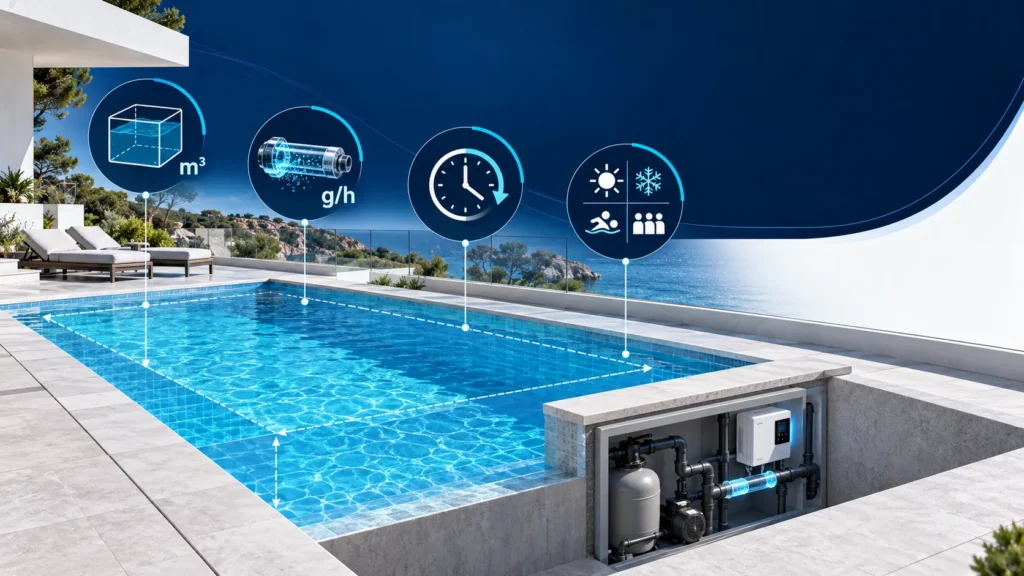
Output (g/h) = (V × FC × FT × FR) / HE
Where:
– V = Volume (m³)
– FC = Load factor (1.0–2.5 depending on use)
– FT = Temperature factor (0.8–1.3)
– FR = UV radiation factor (0.9–1.2)
– HE = Effective hours of electrolysis
2. Actual correction factors
| Parameter | Residential | Community | Hotel/General public |
| Base load factor | 1.0 | 1.5 | 2.0-2.5 |
| Safety margin | 20% | 30% | 40% |
| Hours per day of operation | 8-10 | 12-14 | 16-24 |
| Optimum salinity (g/L) | 4-5 | 3.5-4.5 | 3.5-4.0 |
| Expected service life (h) | 8,000 | 10,000 | 12,000+ |
3. Critical hydraulic considerations
- Passing speed: 1.5–2.0 m/s in the cabin
- Working pressure: 0.8–2.5 bar
- Water temperature: 15–35°C (optimal performance 25–28°C)
- Operating pH: 7.0–7.4 (critical for efficiency)
Technical design and components: a detailed comparative analysis
Electrolytic cells: technology and materials
Domestic:
- Electrodes: Titanium with an MMO (Mixed Metal Oxide) coating
- Coating thickness: 2–4 μm
- Active surface area: 200–400 cm²
- Configuration: Monopolar in series
- Current density: 400–600 A/m²
Industrial:
- Electrodes: Grade 2 titanium with multi-layer MMO coating
- Coating thickness: 6–10 μm
- Active surface area: 600–2000 cm²
- Configuration: Bipolar or parallel monopolar
- Current density: 300–450 A/m²
- Programmable self-cleaning system using polarity reversal
Power supply and control system
Advanced industrial features:
- Switching power supply with PFC (Power Factor Correction)
- Energy efficiency: >92%
- Adaptive microprocessor control
- Modbus RTU/TCP communication
- Integrated data logger (>365 days)
- Configurable alarms with a history log
- Predictive control based on trends
TCO (Total Cost of Ownership): a realistic 5-year financial analysis
Detailed cost model
| Concept | Domestic (100 m³) | Industrial (500 m³) |
| Initial CAPEX | 2,500-4,000€ | 8,000-15,000€ |
| Annual OPEX: | ||
| – Energy (€/year) | 180-250 | 650-900 |
| – Salt (€/year) | 80-120 | 350-500 |
| – Maintenance | 150-200 | 400-600 |
| – Cell (amortisation) | 300-400 | 800-1,200 |
| 5-year TCO | 6,050-8,850€ | 19,000-31,000€ |
| Cost per m³ per year | 12-18€ | 7.6-12.4€ |
ROI and break-even point
- Payback period for industrial investment versus multi-unit residential: 18–24 months
- Savings per m³ treated in industrial applications: 35–45 per cent
- Reduction in incidents through redundancy: 85 per cent
Documented case studies and solutions
Case 1: Residential estate with 40 homes (Madrid)
- Situation: 350 m³, intensive summer use
- Solution: Industrial 35 g/h with partial redundancy
- Result: 0 stoppages in 3 seasons, ROI 20 months
Case 2: Hotel 4★ coast (Mallorca)
- Situation: 800 m³ main pool + 150 m³ children’s pool
- Solution: 2 × 60 g/h with integrated BMS control
- Result: 40% reduction in chemicals, 25% increase in guest satisfaction
Case 3: Premium detached house (Barcelona)
- Situation: 120 m³ with an integrated spa
- Solution: Domestic 25 g/h + pH/ORP control
- Result: Fully automated, monthly maintenance
Integration with auxiliary systems
Professional Installation Protocol
- Pre-installation:
- Spring water analysis (hardness, metals, TDS)
- Hydraulic testing (flow rates, pressures)
- Electrical testing (voltage, earth <10Ω)
- Installation:
- Bypass with shut-off and control valves
- Cell after the filter, before the heater
- Flow and temperature sensor
- Dedicated electrical switchboard with protective devices
- Commissioning:
- Gradual salinity adjustment (500 g/L per day)
- Calibration of pH/ORP/Cl probes
- Scheduling, timetables and instructions
- Certified operator training
Predictive and preventative maintenance
Optimised annual programme
Weekly:
- Verification of actual production against target
- Cleaning the cell pre-filter
- Visual alarm monitoring
Monthly:
- Cell inspection (fouling)
- Polarity reversal check
- Analysis of consumer trends
Quarterly:
- Chemical cleaning of the cell (10% citric acid)
- Probe calibration
- Alarm function test
Annual:
- Coating thickness measurement
- Spectrophotometric analysis of water
- Firmware update
- Installation certification
Applicable regulations and certifications
- UNE-EN 16713-3: Saltwater electrochlorinators
- RD 742/2013: Public swimming pools
- UNE-EN 60335-2-60: Electrical safety
- CE marking compulsory
- NSF/ANSI 50 certification recommended
Professional Quick Decision Checklist
Select ‘DOMESTIC’ if:
- Volume < 150 m³
- Usage < 6 months per year
- Bathers < 20 per day
- Budget < €5,000
- In-house maintenance
Select ‘INDUSTRIAL’ if:
- Volume > 150 m³
- Usage > 8 months per year
- Bathers > 20 per day
- It requires traceability
- Priority ROI
Technical FAQs
How do I work out exactly how much stock is needed for a hotel spa?
For SPAs, use this specific formula: Output (g/h) = (V × 3.5 × Turnover/day) / HE. Example: 10 m³ spa with 8 turnover rates per day and 12 hours of operation = (10 × 3.5 × 8) / 12 = 23.3 g/h. Add a 40 per cent margin = 33 g/h minimum. Take into account high temperatures (35°C), which reduce performance by 20 per cent.
What factors affect the actual lifespan of a cell?
Critical factors by impact:
- pH out of range (>7.6): -40% service life
- Hardness >500 ppm without treatment: -30%
- Polarity reversal < 4 hours: -25%
- Operation without flow: immediate failure
- Salinity < 3 g/L: -20% yield, overheating
Is salt chlorination compatible with copper-silver ionisation?
Yes, but it requires some adjustments: keep the ORP below 650 mV to prevent excessive oxidation of the copper. Reduce chlorine production by 30–40 per cent. Monitor copper (<0.5 ppm) and silver (<0.05 ppm) levels weekly. The pH must be strictly maintained at 7.2–7.4.
 Español
 English (UK)
 Français
 Português