

Is the swimming pool pump making a noise but not starting?
Does the swimming pool pump make a loud humming noise, as if it were trying to start, but the motor doesn’t actually start and the water isn’t circulating?
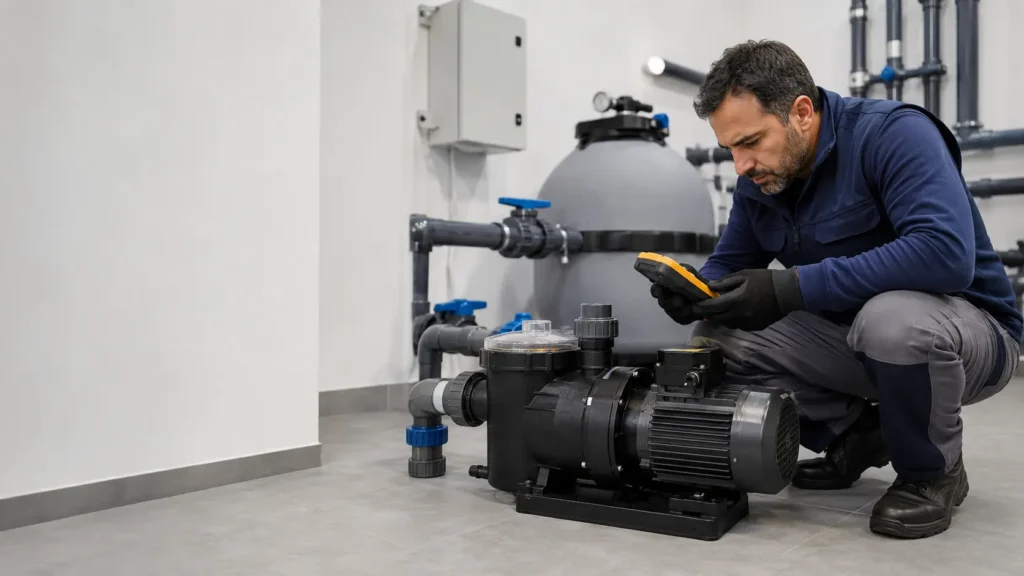
This symptom usually indicates that the motor is receiving power, but a mechanical or electrical fault is preventing the shaft from starting to turn. The first two possibilities to check are a blockage in the shaft or the impeller, and a fault with the motor’s capacitor.
In this guide, we explain how to tell the difference between the two faults, what checks can be carried out, and when it is necessary to remove the engine or contact a repair service.
Quick diagnosis: If the pump hums but does not start, it must be switched off immediately. With the power off, check whether the shaft turns. If it is seized, there is probably a mechanical fault. If it turns freely, the capacitor is one of the first components to check.
What does the humming noise from the pump mean?
The humming sound indicates that the motor is trying to start. However, the rotating assembly does not begin to move and, therefore, the impeller cannot generate water flow.
The pump must not be left switched on whilst waiting for it to start up. If the motor remains powered whilst the shaft is stationary, its temperature may rise and the fault may be exacerbated.
The most common causes are:
| Symptom observed | Possible cause |
|---|---|
| Loud humming noise and seized shaft | Clogged impeller, seized bearings or mechanical jam |
| A buzzing sound and a freely rotating shaft | Faulty capacitor or electrical fault |
| A metallic clanking or scraping noise | Worn bearings |
| Triggering of the motor protection device or protection | Overload, winding, wiring or shunt |
| The motor is running, but it isn’t pumping any water | Failure to prime, air ingress, valve closed or hydraulic problem |
Before replacing the pump, it is important to determine whether the problem lies with the motor, the hydraulics or the electrical system.
Safety before checking the pump
Before handling the equipment:
- Switch off the power supply at the fuse box.
- Check that no timer, contactor or automatic system can switch the pump back on.
- Avoid working with wet hands or with water pooled around the motor.
- Close the valves if any hydraulic components need to be removed.
- Please refer to the manual for the model you have installed.
- Check that the circuit is de-energised before opening the electrical box.
The capacitor may retain a charge even after the pump has been switched off. It must be discharged, checked and replaced by a person with electrical knowledge, using the appropriate tools.
First check: check whether the shaft is jammed
With the pump completely disconnected, check whether the motor shaft can turn.
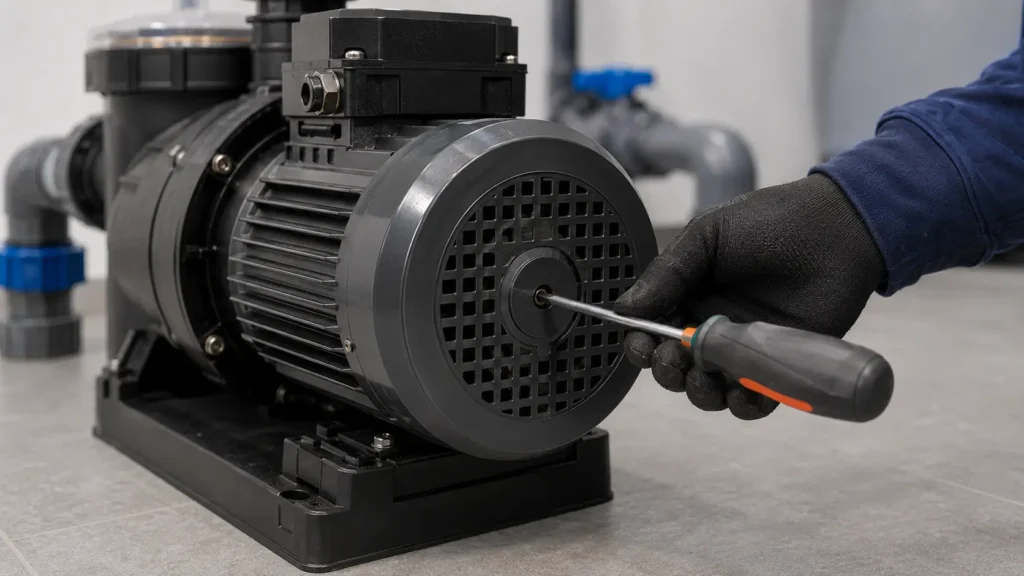
Depending on the model, there may be a slot at the rear of the motor that allows the shaft to be turned using a flat-head screwdriver. On other machines, it may be necessary to remove the fan cover or follow a different procedure.
Before inserting a tool, check the pump manual.
The shaft should move relatively smoothly without the need to apply too much force.
If the shaft rotates correctly
When the shaft can move freely and no significant friction is felt, it is less likely that there is a mechanical jam.
In that case, the capacitor is one of the first electrical components that should be checked.
If the shaft is seized or turns with difficulty
A shaft that does not rotate freely may indicate:
- Impeller blocked by leaves, hair, fibres or small stones.
- Dirt that has built up after a prolonged period of inactivity.
- Seized or worn bearings.
- Corrosion in the engine.
- Water ingress through the mechanical seal.
- Internal damage to the rotating assembly.
Do not force the shaft in an attempt to restore operation. If it does not move smoothly, the pump will need to be dismantled and inspected.
Second check: check the capacitor
If the shaft is turning properly, the next part to check is the capacitor.
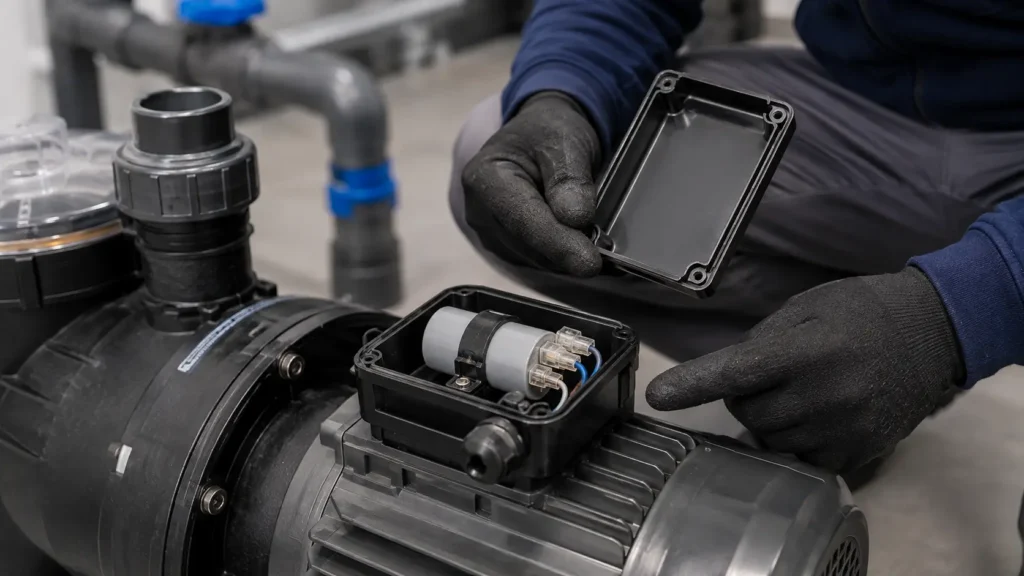
In many single-phase pumps, the capacitor helps the motor generate the momentum needed to start turning. When it loses capacity or deteriorates, the motor may draw current and produce a humming sound without actually starting.
The capacitor is usually found inside the electrical box located at the top, side or rear of the motor. Its location and specifications vary depending on the model.
Signs of a faulty capacitor
Some damaged capacitors exhibit the following:
- Bulging or misshapen casing.
- Cracks.
- Leaks.
- Burnt terminals.
- The smell of a faulty electrical component.
However, the capacitor may also fail without showing any visible damage. To check its condition, its capacitance must be measured using a suitable instrument.
How to choose a compatible capacitor
The capacitance of the capacitor is indicated on its casing and is expressed in microfarads or µF.
In the example shown in the video, a 12 µF capacitor is used, but this figure does not apply to all pumps. The required capacitance depends on the motor’s design and power rating.
The replacement part must comply with the manufacturer’s specifications:
- Same capacitance in microfarads.
- Compatible capacitor type.
- Correct operating voltage.
- Dimensions compatible with the electrical box.
- The same connection system or terminals.
You should not fit a capacitor with a higher capacity on the assumption that it will make the motor more powerful. An incorrect capacity may affect performance and damage other components.
Whenever possible, use the original spare part or a part that is specifically compatible with the pump model.
Replacement and fitting of the condenser
Before disconnecting the terminals, it is advisable to take a photograph of their position and consult the pump’s wiring diagram.
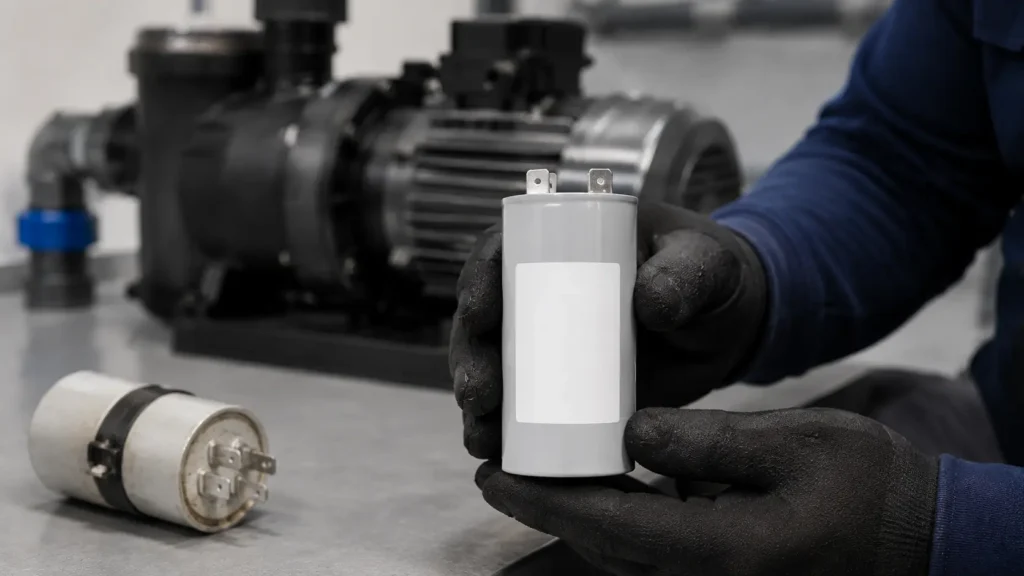
After removing the faulty capacitor, the new one must be fitted in accordance with the original connections and secured correctly inside the housing. The cover must be closed and all screws must be tightened securely to ensure the unit remains protected.
A photograph helps you to remember the position of the cables, but it is no substitute for the wiring diagram and does not confirm that the new component is compatible.
If there are any doubts regarding the discharging of the capacitor, the wiring or the specifications of the replacement part, the repair must be carried out by a technician.
Post-repair check
Once the procedure is complete:
- Check that the electrical box is properly closed.
- Check that there are no tools left behind and that all connections are secure.
- Open the necessary valves.
- Fill the pre-filter with water.
- Prime the pump in accordance with the manufacturer’s instructions.
- Check the lid, the seal and the joints.
- Restore the power supply and carry out the test.
The pump must not be run dry. To check that it is working properly, it must be correctly primed and connected to the hydraulic circuit.
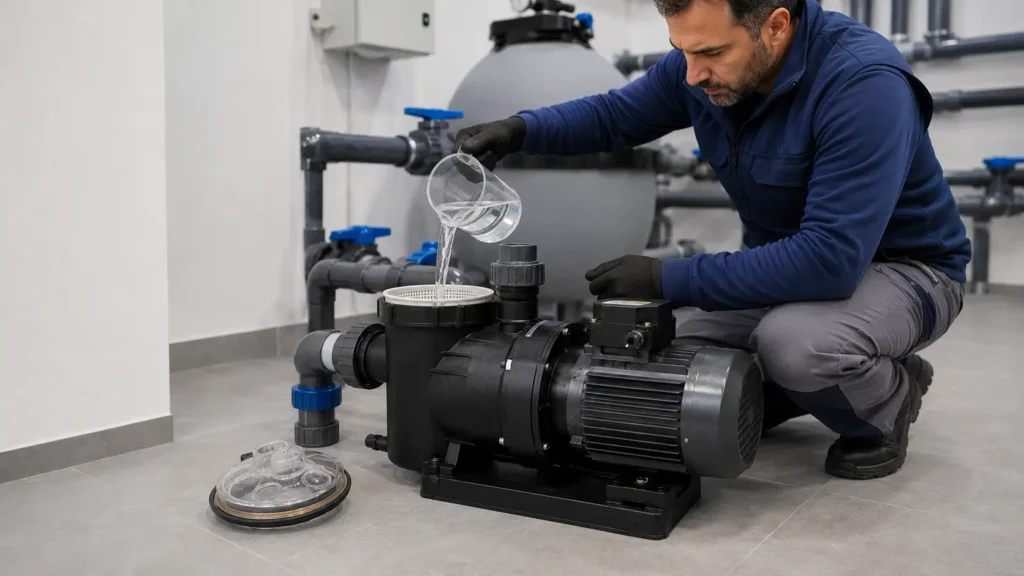
If the motor starts and the pump is circulating water as normal, the problem may have been resolved.
If it continues to buzz without spinning, it must be switched off immediately.
What should you check if the pump still won’t start?
If the shaft turns freely and the capacitor is working properly, the fault may lie in:
- The motor windings.
- Bearings.
- Electrical connections.
- The supply voltage.
- The heat shield.
- The impeller.
- The contactor or motor protector.
- The electrical filtration panel.
In such cases, it will be necessary to check the voltage, current consumption, continuity of the windings and the condition of the protective devices.
It is also advisable to check that the motor protection switch is correctly set for the pump’s rated current. TRYPOOL offers various configurations of electrical filtration panels for single-phase pumps.
Is it better to repair or replace the pump?
Replacing the capacitor may be a sensible repair option when the motor, bearings and hydraulic system are in good condition.
However, it may be more advisable to replace the pump when:
- There are several faults occurring at the same time.
- The bearings and the windings are worn.
- There are signs of corrosion or water ingress.
- The pump has been repaired several times.
- No compatible replacement parts have been found.
- The team is not the right size.
- The aim is to reduce consumption by using a variable-speed pump.
Before choosing a new pump, you should check the volume of the swimming pool, the required flow rate, the filter capacity, the pressure drops, the pipe diameters and the power supply.
You can view the range of TRYPOOL swimming pool pumps, which includes single-speed and variable-speed solutions.
For conventional installations, the TRYPOWER single-phase self-priming pump It is available in different power ratings.
When a project requires the system to be adjusted to meet different filtration requirements, one option to consider is a InverSmart variable-speed pump.
Frequently asked questions
Why does the swimming pool pump hum but not start?
The most common causes are a faulty capacitor, a seized shaft, a blocked impeller or seized bearings. There may also be a problem with the windings, the wiring or the power supply.
Can you leave the pump running to see if it eventually starts up?
No. If the engine does not start to turn over, it must be switched off. Leaving it running whilst it is seized can cause it to overheat and make the fault worse.
How do you check whether the shaft is jammed?
When the power is switched off, some models allow the shaft to be moved using a slot at the rear. Please refer to the manual and do not apply excessive force.
How can you tell if the capacitor is faulty?
A swollen, cracked or leaking capacitor must be replaced. However, it may also fail without showing any visible damage. To confirm this, its capacitance must be measured.
Can a capacitor with a higher microfarad rating be fitted?
No. The capacity specified by the manufacturer must be adhered to. Fitting a capacitor with a higher capacity may affect performance and damage the motor.
Can a swimming pool pump be tested without water?
No. The pump must be primed and tested whilst connected to the hydraulic circuit. Dry running may damage the mechanical seal and other internal components.
Conclusion
When a swimming pool pump makes a noise but does not start, the first two things to check are whether the shaft is turning and the condition of the capacitor.
A seized shaft usually indicates a mechanical problem, such as a blocked impeller or worn bearings. If the shaft rotates freely, the capacitor is one of the first components that should be checked.
Before replacing the pump, the entire system must be checked: the motor, the hydraulic components, the safety devices and the control panel. This diagnostic check enables the actual fault to be identified and prevents unnecessary replacement of equipment.
TRYPOOL works exclusively with professionals in the swimming pool sector. Installers, builders, maintenance contractors and distributors can register on our platform to view our pumping and filtration solutions.
If you are a private individual, you can contact TRYPOOL and we’ll help you find a solution with the help of a professional.
Content created using AI and reviewed by a human to provide clear and understandable technical information.


 Español
 English (UK)
 Français
 Português