

Solar panels for swimming pools can be used to cover part of the energy consumption of the filtration system, water treatment, the heat pump and the lighting.
However, not all solutions work in the same way. Photovoltaic panels generate electricity, whilst solar thermal collectors use the sun’s heat to raise the temperature of the water.
Before choosing a system, you need to consider which devices you want to power, when they are in use and how much power they require.
What types of solar panels can be used?
Photovoltaic solar panels
Photovoltaic panels convert solar radiation into electricity. This energy can be used to power:
- Filter pump.
- Salt chlorinator.
- pH dosing pump.
- Automation panel.
- Heat pump.
- Lighting.
- Auxiliary equipment.
In a home with grid-connected self-consumption, the panels are not usually connected individually to each appliance. The electricity generated passes through an inverter and is fed into the main electrical system.
The pool control panel, with its associated circuits and protective devices, is powered from that installation.
Solar thermal collectors
Solar thermal collectors do not generate electricity. Their function is to transfer heat from the sun to water.
Depending on the design, the pool water can either circulate directly through suitable collectors or absorb heat via a separate circuit and a heat exchanger.
This solution is primarily designed to heat a swimming pool using solar panels
Which swimming pool equipment can utilise photovoltaic energy?
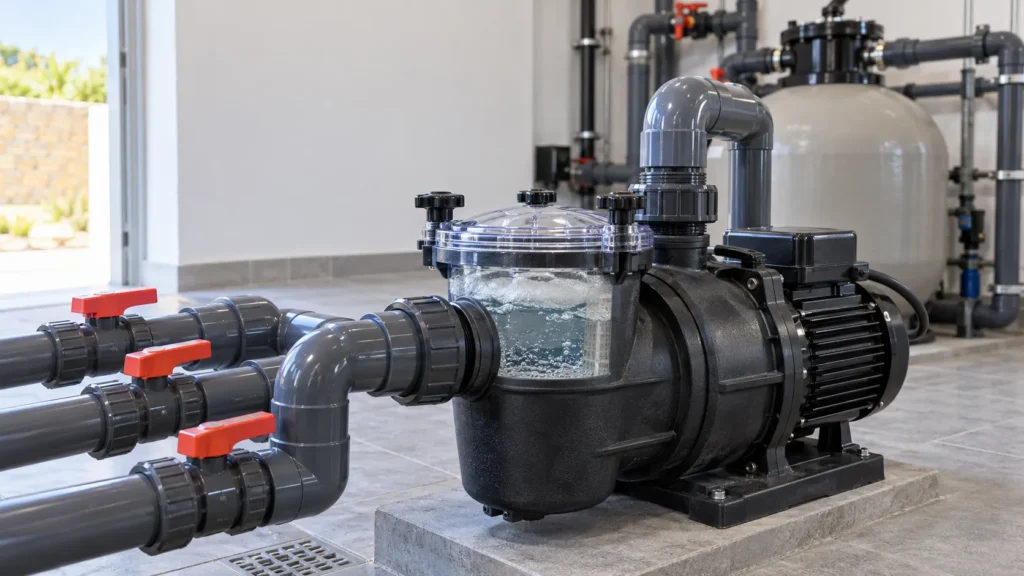
Filter pump
The pump is usually one of the main sources of electricity consumption in a swimming pool. Scheduling part of the filtration process to take place during hours when the sun is shining helps to improve self-consumption.
However, solar power does not compensate for an incorrectly sized pump. The selection must be based on:
- Pool volume.
- Recirculation time.
- Required flow rate.
- Pressure drops.
- Pump performance curve.
- Permissible flow rate through the filter.
The variable speed pumps They allow the operation to be adapted to different tasks. This does not mean that they can be connected directly to control panels: their power supply must always be checked.
Water treatment
The salt chlorinator, pH control system and other equipment can operate whilst filtration is in progress.
If these devices rely on water circulation, the solar control programme must take this relationship into account. A treatment unit that requires a flow of water must not remain active when the pump is switched off.
Heat pump
A photovoltaic system can provide some of the electricity needed by a swimming pool heat pump.
A heat pump should not be chosen solely on the basis of its advertised maximum capacity. The following factors should also be taken into account:
- Location.
- Outside temperature.
- Months of use.
- Desired temperature.
- Water surface.
- Wind.
- Existence of a roof.
- Performance under real-world conditions.
LED lighting
The LED lighting for swimming pools It can also form part of a system powered by photovoltaic energy.
The main limiting factor is the timing. Solar panels generate electricity during the day, whilst lights are used at night. For this reason, the lighting requires either grid connection or battery storage.
You can find further information in the guide on pool lighting powered by solar panels
Three ways to power a swimming pool using solar energy
1. Grid-connected self-consumption
It is the standard solution for homes and businesses.
The general flow of energy is as follows:
Panels → inverter → main distribution board → swimming pool distribution board → equipment
The electricity grid supplies the energy that is lacking when solar generation is insufficient. If there is a surplus, it can be used to power other appliances or managed in accordance with the self-consumption scheme agreed upon.
2. Direct solar pumping
In a direct solar pumping system, the panels power a controller, which in turn controls a compatible pump.
Operations are adjusted to match available production. They can start at a reduced rate in the morning, increase during the middle of the day and decrease towards the end of the day.
A conventional pump must not be connected directly to the panels without first checking:
- Engine type.
- Operating voltage.
- Starting current.
- Power.
- Single-phase or three-phase power supply.
- Driver compatibility.
3. Off-grid installation with batteries
Where there is no mains electricity supply, or where power is required outside daylight hours, a battery-powered system can be installed.
As well as the panels, you will usually need:
- Hybrid regulator or inverter.
- Batteries.
- Protections.
- Distribution board.
- Control system.
- A possible source of support.
The battery capacity must be calculated on the basis of power consumption, the desired runtime and system losses.
How many solar panels does a swimming pool need?
There is no universal figure. The calculation must take into account:
- Electrical power consumed by each piece of equipment.
- Hours of operation per day.
- Daily consumption expressed in kilowatt-hours —kWh—.
- The time of day when consumption takes place.
- Installed photovoltaic capacity, expressed in kWp.
- Available solar radiation.
- Orientation and inclination.
- Shadows.
- Conversion losses.
- Mains power or batteries required.
The official tool PVGIS enables the estimation of photovoltaic output based on location.
For information on the pump, please see the article on solar panels for swimming pool water treatment systems.
Do I need to fit batteries?
Not always.
A mains-connected system can operate without batteries because the mains supply provides the missing power. Filtration can also be programmed to take place during daylight hours.
Batteries make the most sense when:
- There is no electricity supply.
- Self-contained night-time lighting is required.
- The filtration must continue without sunlight.
- Food is sought during power cuts.
- There are other types of night-time consumption.
- A certain level of autonomy is required.
Electrical safety
The presence of water and swimmers means that the swimming pool is an environment with special electrical requirements.
ITC-BT-31 of the Low-Voltage Electrotechnical Regulations sets out conditions for:
- Protection volumes.
- Pipes.
- Junction boxes.
- Light fittings.
- Electrical equipment.
- Security sources.
- Measures to protect against electric shock.
The photovoltaic installation does not replace these measures.
The project must be co-ordinated between a swimming pool specialist and a qualified electrical installation company.
Which solution should you choose?
| Need | A solution that should be considered |
|---|---|
| Reducing overall consumption | Grid-connected self-consumption |
| Filling the pump during the day | Self-consumption or direct solar pumping |
| Heat the water directly | Solar thermal collectors |
| Maintain a controlled temperature | Photovoltaics and heat pumps |
| Lighting at night | Mains supply or batteries |
| Swimming pool with no mains power supply | A correctly sized off-grid system |
Conclusion
Solar panels can be integrated with water purification, wastewater treatment, air conditioning and lighting. The outcome will depend on a design that coordinates solar energy production with actual consumption.
It is not just a matter of installing panels. You also need to choose the right pump, filter, switchboard, air conditioning, lighting and control systems.
Are you designing an energy-efficient swimming pool?
At Trypool, we work with you to analyse your project and help you select the swimming pool equipment to be included in the installation.
We work exclusively with professionals.
Telephone: 868 127 790
Email: pedidos@trypool.com
If you are a private individual, please contact us and we will put you in touch with a professional.
Only if the pump and the controller are designed to work together. A conventional pump must not be connected directly to the control panels.
Not directly. They generate electricity that can power a heat pump.
Yes, within a compatible electrical installation. Its operation must be co-ordinated with the flow rate and the filter pump.
It requires batteries or grid support because it is normally used when there is no longer any solar generation.
It depends on the equipment’s power consumption, its operating hours, the available radiation and the type of system.
Content created using AI and reviewed by the Trypool technical team.
 Español
 English (UK)
 Français
 Português