

Fundamentals of filtration: theory and application
Introduction
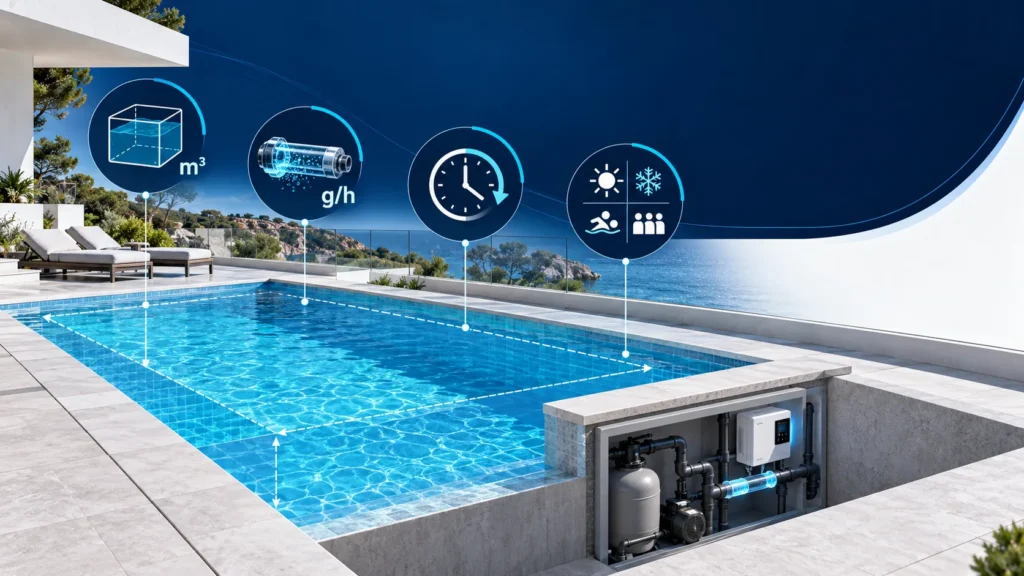
Professional swimming pool filtration is not simply a matter of choosing a filter based on the volume of the pool. To achieve adequate circulation, it is necessary to calculate the flow rate, determine the filtration speed, check for pressure drops and select a pump capable of operating at the system’s actual hydraulic point.
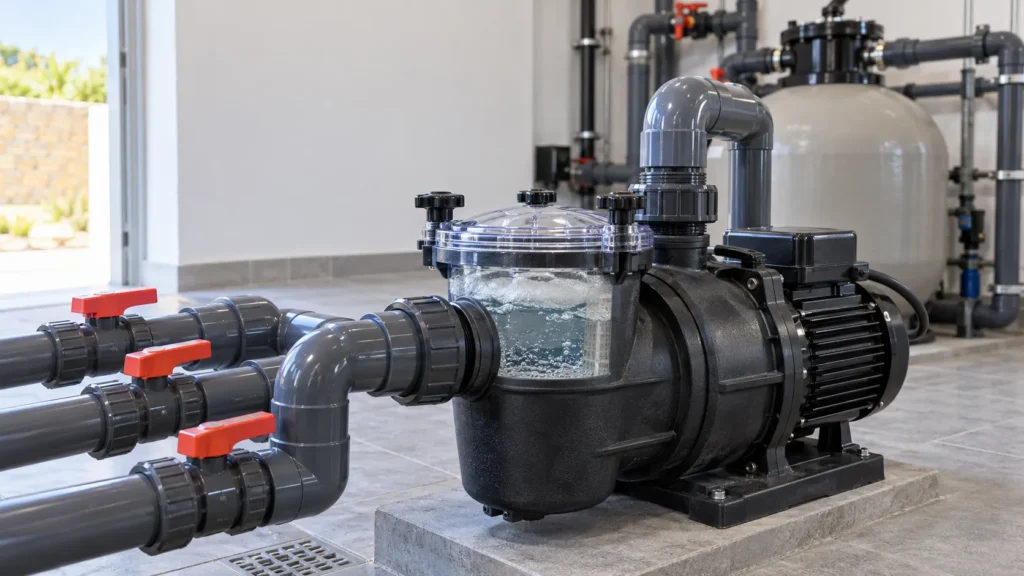
The filter, pump, pipework, valves and tank components form a single system. A correctly sized filter may malfunction if the pump delivers an excessive flow rate, whilst a powerful pump will not compensate for a hydraulic system with insufficient pipe diameters or high pressure drops.
In this guide, we explain the calculation process step by step and the details that need to be checked before selecting professional swimming pool filtration equipment
What components make up the filtration system?
A filtration system consists of various components that must work in coordination:
- Drains, skimmers or an overflow channel.
- Suction pipes.
- Pump pre-filter.
- Circulation pump.
- Filter.
- Selector valve or valve block.
- Treatment and air-conditioning equipment.
- Return pipes.
- Discharge nozzles.
- Electrical switchboard and control systems.
Before selecting the filter, it is necessary to understand the full path taken by the water. Each section of pipework, elbow, valve and piece of equipment introduces a resistance that affects the final flow rate.
Trypool has a specific category of swimming pool filtration including filters, valves, compact units and equipment rooms for different types of installation.
Step 1: Calculate the filtration flow rate
Flow rate is the volume of water that must pass through the system in one hour.
The basic formula is:
Q = V / T
Where:
- Q: required flow rate, expressed in m³/h.
- V: volume of the vessel, expressed in m³.
- T: expected recirculation time, expressed in hours.
Where the project specifies several refurbishments over the course of its operational life, this may also be expressed as:
Q = V × N / H
Where:
- No.: number of recirculations planned.
- H: available operating hours.
Example of flow rate
Let’s take the example from the original article:
- Tank capacity: 500 m³.
- Planned recirculations: 4.
- Time available: 14 hours.
The calculation would be:
Q = 500 × 4 / 14 = 142.9 m³/h
The system should provide approximately 143 m³/h at its actual operating point.
This result does not yet determine which pump should be installed. First, the filter and pressure drops must be calculated.
How to choose the recirculation time
A single time should not be used for all swimming pools. The following should be taken into account:
- Residential, community, hotel, sports or public use.
- Volume and geometry of the vessel.
- Maximum number of bathers.
- Opening hours.
- Overflow system or skimmers.
- Project terms and conditions.
- Applicable health regulations.
State regulations require that recirculated water be filtered and disinfected before being returned to the pool. Furthermore, chemical treatment must be carried out via the treatment circuit, except in justified circumstances and when the pool is closed.
Step 2: Determine the filtration rate
The filtration rate indicates how many cubic metres pass through each square metre of filter surface area in one hour.
It is expressed as:
m³/h/m²
For the same flow rate:
- A lower flow rate requires a larger filter area.
- A higher speed allows a smaller filter to be used.
- Excessive speed may reduce the contact time with the medium.
- The speed must be compatible with the filter, the medium and the application.
Manufacturers offer filters configured for different flow rates. Fluidra’s official documentation lists options of 20, 30, 40 and 50 m³/h/m², which confirms that the flow rate should be selected as a design criterion rather than as a universal figure.
Guideline
| Speed | Impact on sizing |
|---|---|
| 20 m³/h/m² | Larger filter area |
| 30 m³/h/m² | Frequently used in demanding installations |
| 40 m³/h/m² | A compromise solution |
| 50 m³/h/m² | Smaller surface area for the same flow rate |
This table is not a substitute for the documentation for each filter. The maximum flow rate specified by the manufacturer must be adhered to at all times.
Step 3: Calculate the filter area
The required area is calculated as follows:
A = Q / Vf
Where:
- To: filter area in m².
- Q: required flow rate in m³/h.
- Vf: filtration rate in m³/h/m².
Example with a speed of 30 m/h
For a flow rate of 143 m³/h:
A = 143 / 30 = 4.77 m²
Once the area has been calculated, the theoretical diameter can be estimated:
D = √(4 × A / π)
For an area of 4.77 m²:
D ≈ 2.46 m
Therefore, a commercial filter close to 2,500 mm in diameter.
Fluidra’s official documentation on wound filters includes filters with a diameter of 2,500 mm, an approximate surface area of 4.90 m² and flow rate configurations for different speeds.
Indicative table of floor areas
| Diameter | Surface | Flow rate at 30 m/h | Flow rate at 50 m/h |
|---|---|---|---|
| 500 mm | 0.196 m² | 5.9 m³/h | 9.8 m³/h |
| 600 mm | 0.283 m² | 8.5 m³/h | 14.1 m³/h |
| 750 mm | 0.442 m² | 13.3 m³/h | 22.1 m³/h |
| 900 mm | 0.636 m² | 19.1 m³/h | 31.8 m³/h |
| 1,200 mm | 1,131 m² | 33.9 m³/h | 56.5 m³/h |
| 1,400 mm | 1,539 m² | 46.2 m³/h | 77.0 m³/h |
| 1,600 mm | 2,011 m² | 60.3 m³/h | 100.5 m³/h |
| 1,800 mm | 2,545 m² | 76.4 m³/h | 127.2 m³/h |
| 2,000 mm | 3,142 m² | 94.2 m³/h | 157.1 m³/h |
| 2,500 mm | 4,909 m² | 147.3 m³/h | 245.4 m³/h |
The table is based on the geometric area. The final commercial flow rate may vary depending on the manufacturer, the bed height, the collectors and the filter configuration.
For private swimming pools, please refer to the household filters, whilst systems with a higher flow rate should be inspected within the range of industrial swimming pool filters
Step 4: Calculate the pressure drops
A pump should not be selected solely on the basis of its flow rate or motor power. It must also be capable of overcoming the hydraulic resistance of the entire system.
The total manometric head can be expressed in simplified form as:
HMT = losses in pipes + fittings + filter + equipment + net static head
The following should be taken into account:
- Actual length of the suction and return pipes.
- Inner diameter of the pipes.
- Water velocity.
- Elbows, T-joints and reducers.
- Valves.
- Filter.
- Heat exchanger.
- Chlorinator, cell or treatment unit.
- Flow meters and non-return valves.
- Difference in level where there is actually a difference between free surfaces.
Pipe losses
The Hazen-Williams formula can be used to estimate friction loss in water pipes:
hf = 10.67 × L × Q¹·⁸⁵² / C¹·⁸⁵² × D⁴·⁸⁷
Where:
- hf: pressure drop in metres.
- L: length of the pipe.
- Q: flow rate in m³/s.
- C: material coefficient.
- D: internal diameter in metres.
It is important to use the actual internal diameter, not just the nominal external diameter.
Losses on fittings
Elbows, valves, T-pieces and reducers can be calculated using:
- Equivalent lengths.
- Loss coefficients K.
- Data provided by the manufacturer.
A common error relating to geometric height
The total vertical distance covered by the pipes should not be added up automatically.
In a closed circuit, part of the head caused by the rising water is offset by the falling water. Only the net static head that actually affects the system should be taken into account, in addition to friction losses and equipment losses.
Step 5: Select the filter pump
Once the flow rate and total head are known, a pump must be selected whose hydraulic curve passes through the calculated operating point.
The workstation consists of:
- Required flow rate.
- Total manometric head.
For example:
143 m³/h at 17 mca
It is not enough simply to choose a pump whose technical specifications state 143 m³/h, as that flow rate may have been measured at a different head.
Points to check
- Flow and pressure curve.
- Performance at the operating point.
- Required NPSH.
- Suction and discharge diameters.
- Electrical compatibility.
- Materials.
- Pre-filter capacity.
- Noise level.
- Number of pumps required.
- Possibility of redundancy or spare capacity.
Variable-speed pumps – professional swimming pool filtration
The variable speed pumps allow the operation to be adapted to different situations:
- Routine filtration.
- Periods of low load.
- Cleaning.
- Backwash.
- Night-time operation.
- Integration with automated systems.
Reducing the flow rate may lower consumption, but the flow rate must never fall below the levels required for circulation, water treatment or the proper functioning of the filter.
Retention mechanisms – professional swimming pool filtration
- Mechanical sieving: Particles >40μm
- Sedimentation: Speed <20 m/h
- Adsorption: Van der Waals forces
- Biological action: Biofilm in granule form
Choosing a filter medium – professional swimming pool filtration
The filter medium affects particle retention, maintenance and water consumption.
Silica sand
It is a solution widely used in swimming pool filters. The following must be observed:
- Specified particle size.
- Total quantity.
- Bed height.
- Layer distribution.
- Filtration and backwash rates.
Filter glass
Glass media can be produced in a range of particle sizes and configurations.
An automatic reduction in quantity or a fixed service life should not be applied without consulting the manufacturer’s technical data sheet.
Cartridges
Cartridge filters do not undergo the same backwash process as a sand filter. Maintenance involves removing and cleaning the filter elements or replacing them when necessary.
Trypool offers compact filtration units for installations where the aim is to integrate a pump and filter into a compact unit.
Other media
Zeolite, diatomaceous earth and other media require a specific assessment based on:
- Equipment used.
- Desired filtration quality.
- Maintenance procedure.
- Availability of spare parts.
- Health and operational requirements.
How to backwash a filter – professional swimming pool filtration
Backwashing reverses the flow of water to dislodge the dirt that has built up in the filter bed.
It should be carried out when:
- The differential pressure increases.
- The flow rate decreases.
- This is stated by the manufacturer.
- Dirt is detected following a specific incident.
- This is determined by the maintenance programme.
You should not stick to a single fixed frequency, as two swimming pools can accumulate dirt at very different rates.
General sequence
- Stop the pump.
- Set the valve to the wash position.
- Start the pump.
- Continue washing for the recommended time.
- Stop the pump.
- Set the valve to the rinse position.
- Rinse.
- Stop the pump.
- Return to the filtration position.
The position of a manual selector valve must never be changed whilst the pump is running.
Calculation of wash water
The correct formula is:
V = A × Vl × t / 60
Where:
- V: volume of water used in m³.
- To: filter area in m².
- Vl: washing speed in m/h.
- t: wash time in minutes.
Example
For a filter with a diameter of 1,800 mm:
- Area: 2,545 m².
- Washing speed: 55 m/h.
- Time: 4 minutes.
V = 2.545 × 55 × 4 / 60
V = 9.33 m³
Speed and time are merely an example. They must be replaced with the values specified for the filter and medium installed.
Automation of the filtration system
Automation can improve the control of community, hotel, sports and industrial facilities.
Variables that can be monitored
- Filter inlet pressure.
- Outlet pressure.
- Differential pressure.
- Instantaneous flow rate.
- Level of the expansion tank.
- Pump status.
- Electric alarms.
- Valve position.
- Operating hours.
- Energy consumption.
- Turbidity, where the project so provides.
Automation of the washing process
An automatic wash cycle can be started by:
- Differential pressure.
- Flow reduction.
- Temporary timetable.
- A combination of several conditions.
The logic must prevent backwashing from starting if there is insufficient liquid level in the expansion tank or if the valves are in the wrong position.
Preventative maintenance – professional swimming pool filtration
The frequency must be adjusted to suit the type of installation and the manufacturers’ instructions.
Frequent checks
- Check the pressure gauges.
- Check the flow rate.
- Visually inspect the water.
- Clean the pump’s pre-filter.
- Check for any draughts.
- Check for leaks.
Regular checks
- Check the differential pressure.
- Check valves and seals.
- Clean or calibrate instruments.
- Check the condition of the medium.
- Check manifolds and strainers.
- Inspect the inside of the filter as and when necessary.
A filter media change should not be carried out every five years for all filters. The decision to replace the media should be based on the condition of the media, any loss of performance, channeling, and the manufacturer’s recommendations.
| Problem | Possible causes | Checks |
|---|---|---|
| Turbid water | Insufficient flow, excessive velocity, degraded medium or incorrect treatment | Check the flow rate, pressure, medium and water parameters |
| High blood pressure | Dirty filter, closed valve or blocked pipe | Compare with the initial pressure and check the return flow |
| Low pressure | Air intake, dirty pre-filter or suction problem | Check the water level, skimmers, pipes and pre-filter |
| Washing very frequently | Small filter, high load or partially clogged | Check the surface, flow rate and condition of the riverbed |
| Sand in the glass | Damaged collectors or incorrect particle size distribution | Inspect the interior and surroundings |
| Noisy pump | Cavitation, insufficient suction flow or air | Check the NPSH, pipework, level and valves |
| Insufficient flow rate | High losses, an unsuitable pump or small pipework | Measuring flow rate and calculating the system curve |
| Channels in the riverbed | Irregular distribution or compacted medium | Inspect and level the bed |
Total cost of a professional swimming pool filtration system
The cost comparison should not be limited to the price of the filter.
It is worth considering:
- Price of the filter.
- Price of the pump.
- Filter medium.
- Electricity consumption.
- Water used for washing.
- Labour.
- Maintenance.
- Spare parts.
- Service life of components.
- Downtime costs.
- Automation.
The total cost can be expressed as:
TCO = initial investment + energy + water + maintenance + spare parts
Only after compiling this data for an actual installation can a reliable return on investment be calculated.
Regulations and water quality
For swimming pools falling within its scope, Royal Decree 742/2013 stipulates that recirculated water must be filtered and disinfected before being returned to the pool.
It also requires that the treatment methods used must ensure compliance with water quality criteria and that chemicals must not be applied directly to the pool, except in justified circumstances, when there are no bathers present and the safety period is observed.
In addition to the national framework, the following should be reviewed:
- Regional legislation.
- Local by-laws.
- Technical project.
- Requirements of the health authority.
- Manufacturers’ instructions.
- Regulations applicable to this type of swimming pool.
Conclusion
The correct sizing of a filtration system follows a clear sequence:
- Work out the volume of the glass.
- Set the recirculation time.
- Achieve the required flow rate.
- Select the filtration rate.
- Calculate the filter area.
- Assess the pressure drops.
- Select the pump using its performance curve.
- Check the backwash.
- Check pipes, valves and equipment.
- Adjust the system during commissioning.
Browse the range of filters, valves and filtration solutions for swimming pools or contact Trypool to discuss the equipment required for an installation.
The flow rate is calculated by dividing the volume of the pool by the recirculation time specified in the design. If a swimming pool has a volume of 100 m³ and must be recirculated in five hours, the theoretical flow rate will be 20 m³/h.
It depends on the filter, the filter media, the type of swimming pool and the required water quality. Manufacturers offer settings at different speeds, so the value specified for the selected model must be used.
First, the flow rate is divided by the filtration rate to obtain the area. The theoretical diameter is then calculated from that area, and the next suitable standard diameter is selected.
No. The flow rate must be related to the total head. The pump must deliver the required flow rate at the point where its curve matches the system resistance.
When the differential pressure increases, the flow rate decreases or the criterion specified by the manufacturer is reached. The time frequency may be used as a supplementary factor, but it should not be the sole criterion.
It depends on the filter surface area, the backwash rate and the duration. It is calculated by multiplying these three values and dividing the result by 60 when the time is expressed in minutes.
This may be due to damaged internal collectors, filter media that is too fine, an excess of filter media, or an incorrect backwash speed.

 Español
 English (UK)
 Français
 Português