

Differences between AISI 304 and AISI 316 stainless steel
AISI 304 and AISI 316 are two grades of stainless steel used in the manufacture of metal fittings and components. At first glance, they may appear identical, but there are significant differences in their composition and their resistance to certain environments.
In the swimming pool sector, these designations appear on handrails, steps, waterfalls, piezoelectric push-buttons, trim fittings, fastenings and other fittings exposed to water, moisture and the products used in pool treatment.
Understanding the differences between AISI 304 and AISI 316 enables you to correctly interpret the specifications provided by the manufacturer and understand why certain fittings are made from a specific grade of stainless steel.
What does AISI stand for?
AISI is a designation system used to identify different grades of steel.
AISI 304 and AISI 316 belong to the austenitic stainless steel family. Both consist mainly of iron, chromium and nickel.
Chromium allows an extremely thin passive layer to form on the surface. This layer protects the metal from oxidation and can regenerate provided the right conditions are maintained.
However, the term “stainless” does not mean that the material is completely immune to staining or corrosion. Its performance also depends on the finish, manufacture, installation, environment and maintenance.
What is AISI 304 stainless steel?
AISI 304 is one of the most widely used grades of stainless steel. Its composition consists mainly of chromium and nickel, and its standard European equivalent is EN 1.4301.
It is used in industrial equipment, tanks, furniture, decorative items, food-grade installations and a wide range of accessories intended for use in moderate environments.
There is also AISI 304L, which is usually equivalent to the European standard EN 1.4307. The letter “L” indicates that this is a variant with a lower carbon content.
What is AISI 316 stainless steel?
AISI 316 also contains chromium and nickel, but it also contains molybdenum.
The presence of molybdenum is the main difference between AISI 304 and AISI 316. This element improves the steel’s resistance to certain types of localised corrosion associated with chloride-containing environments.
The standard European equivalent of AISI 316 is EN 1.4401. Its low-carbon variant, AISI 316L, usually corresponds to EN 1.4404.
AISI 316L is frequently used in swimming pool fittings such as:
- Railings and handrails.
- Access stairs.
- Stainless steel waterfalls.
- Piezoelectric push-buttons.
- Screws and fasteners.
- Headlamp trims.
- Accessories for spas and hydromassage areas.
To find out more about its composition and uses, you can read the TRYPOOL post on What is AISI 316 stainless steel?.
Comparison table: AISI 304 versus AISI 316
| Feature | AISI 304 | AISI 316 |
|---|---|---|
| Family | Austenitic stainless steel | Austenitic stainless steel |
| Key elements | Chromium and nickel | Chromium, nickel and molybdenum |
| Molybdenum | It is not added intentionally | Yes |
| General resistance to corrosion | Good | Superior in chloride-containing environments |
| Standard European equivalence | EN 1.4301 | EN 1.4401 |
| Low-carbon option | AISI 304L | AISI 316L |
| Visual identity | It doesn't look reliable at first glance | It doesn't look reliable at first glance |
| Common uses | General equipment and moderate environments | Accessories subject to the most demanding conditions |
The exact percentages of each element may vary within the limits specified for each grade. To confirm the composition of a specific part, please refer to its material certificate.
Molybdenum: the key difference – differences between AISI 304 and AISI 316
Molybdenum improves the resistance of stainless steel to localised corrosion.
Among the phenomena against which it offers greater protection are:
- Pitting corrosion: small dots that can penetrate into the metal.
- Crevice corrosion: It may appear at joints, seams, around screws or in areas where water collects.
- Chloride-induced attack: particularly relevant in environments where salts are present.
For this reason, AISI 316 and AISI 316L are used in many fittings that are exposed to water, splashes or moisture.
However, the presence of molybdenum does not make the material completely immune. The surface finish, welds, geometry, cleanliness and working conditions continue to influence its behaviour.
Differences between AISI 316 and AISI 316L
The letter “L” comes from low-carbon and points out that the steel has a low carbon content.
This property helps to reduce the risk of intergranular corrosion associated with certain welding processes. For this reason, AISI 316L is frequently used to manufacture fittings that include welded parts.
The superior resistance to chlorides is primarily due to molybdenum, which is present in both AISI 316 and AISI 316L. The lower carbon content of 316L is particularly significant in the manufacturing and welding processes.
Why is AISI 316L used in swimming pool fittings?
The handrails, steps, water features and push-button controls installed around the pool are exposed to conditions that differ from those of other general-purpose metal components.
Depending on their role, they may come into contact with:
- Treated water.
- Splashes.
- Constant humidity.
- Condensation.
- Dissolved salts.
- Treatment products.
- Continuous cycles of wetting and drying.
- Places near the sea.
- Areas where water may accumulate.
These conditions explain why AISI 316L is used in various professional fittings.
It is also important to monitor the water parameters. Proper maintenance should include regular measurements of pH, disinfectant levels, alkalinity and salinity, where applicable. You can find further information on this in the guide on Which parameters should be measured in swimming pool water?.
Examples of fittings made from AISI 316L
Railings and handrails
Handrails provide a point of support when accessing the pool and in areas near the steps.
The FX01 handrail with welded bracket It is made from AISI 316L stainless steel with a high-gloss polished finish. It is fitted onto the coping using the integrated mounting plates.
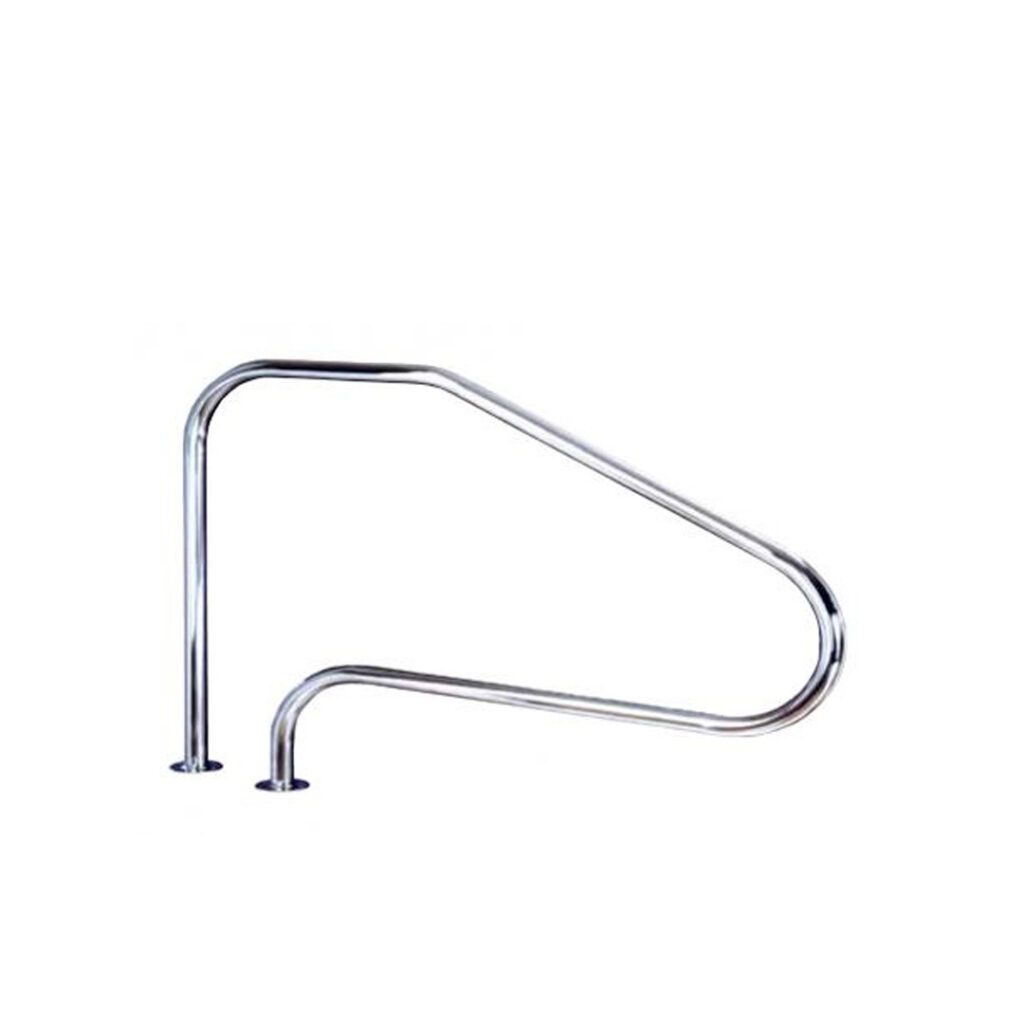
Alternative text: FX01 handrail made from AISI 316L stainless steel with a welded base plate for swimming pools.
Recommended link in the image:
https://trypool.com/producto/barandilla-fx01-pletina/
Pool ladders
A staircase comprises handrails, steps, fixings, bolts and screws, and various connection points. Stainless steel forms part of both the structure and the fastenings.
The TRYPOOL standard AISI 316L ladder It is available with three, four or five rungs. It features Ø43 × 1.2 mm tubing and a high-gloss finish.
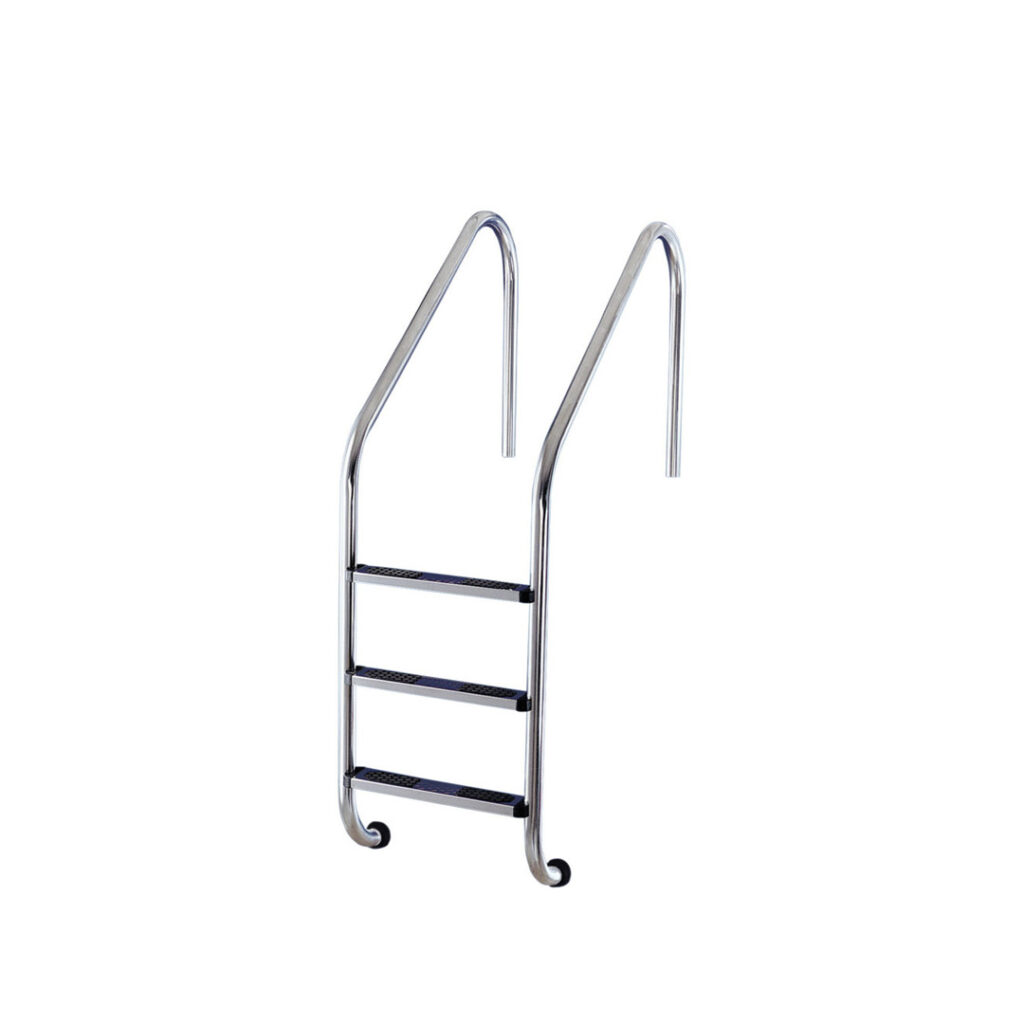
Alternative text: Standard swimming pool ladder made from AISI 316L stainless steel.
Recommended link in the image:
https://trypool.com/producto/escalera-standard-aisi-316l-piscina/
Stainless steel waterfalls
Waterfalls are fittings that remain in direct contact with water whilst in operation.
The Bali Mini waterfall It is made of AISI 316L stainless steel and has an outlet width of 350 mm.
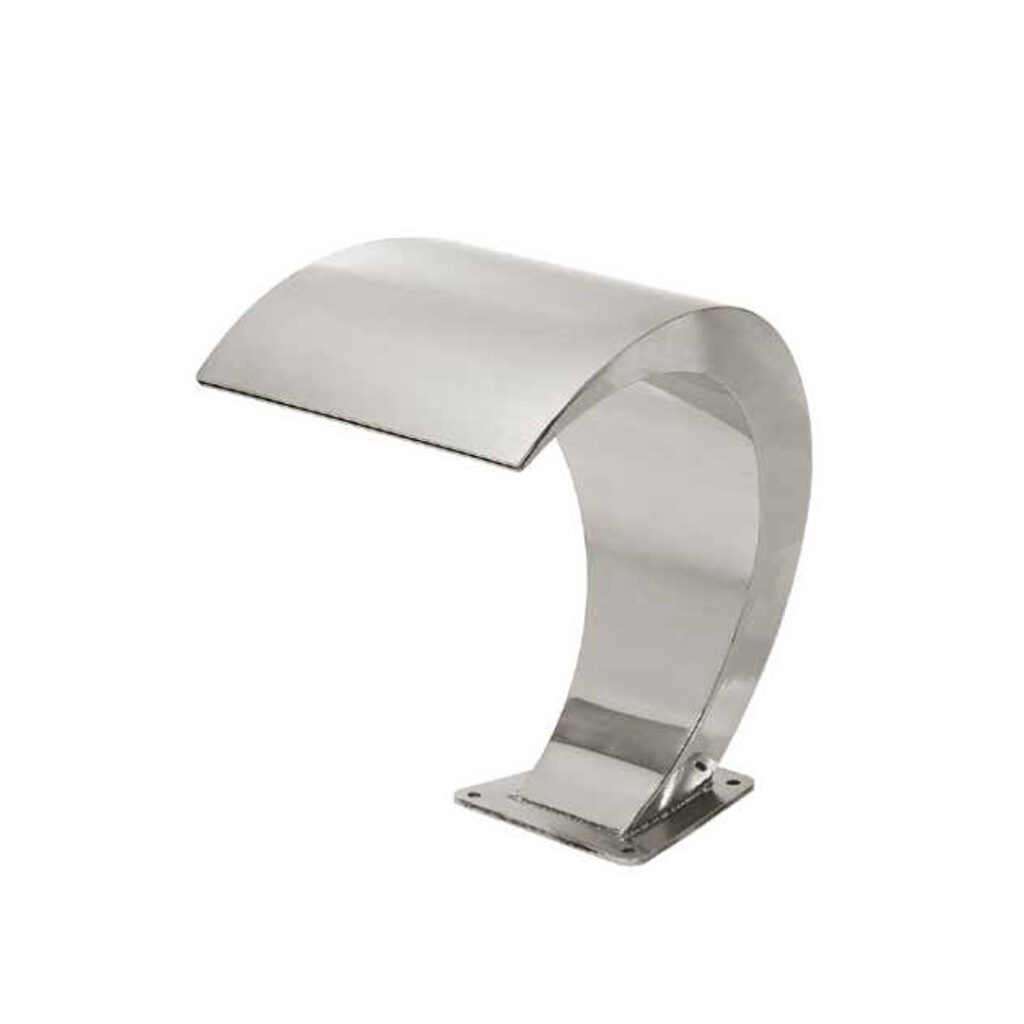
Alternative text: Bali Mini pool waterfall made from AISI 316L stainless steel.
A waterfall needs a sufficient flow rate to form a continuous sheet of water. This is explained in the guide on What sort of pump does a swimming pool waterfall need?.
Piezoelectric push-buttons
Piezoelectric push-buttons enable auxiliary equipment for swimming pools, spas and hydromassage areas to be operated via a compatible control panel.
The AISI 316L piezoelectric push-button The TRYPOOL has a diameter of 22 mm and supports a maximum voltage of 12/24 V AC/DC.
It is manufactured from AISI 316L to withstand the humidity and exposure typical of these areas. The connection, voltage and compatibility must be checked in the technical data sheet and on the relevant control panel.
Fittings for swimming pool lighting
AISI 316L is not used solely for the manufacture of complete fittings. It is also found in smaller components, such as screws and fasteners.
The Liner kit for TRYLED Ultra-Slim Epoxy Projector Includes a cross-piece, a 2-inch gland, seals and AISI 316L fasteners.
This example demonstrates that the quality of the steel is also important in small components located at fastening and sealing points.
Can an AISI 316L fitting develop stains?
Yes. The term “stainless” does not mean that the material can never develop stains or corrosion.
Common causes include:
- Accumulation and drying of salt on the surface.
- Limescale or dirt build-up.
- Concentrated chemical residues.
- Contamination with iron particles.
- Use of carbon steel tools.
- Damaged welds or finishes.
- Water trapped in joints, screws or connections.
- Lack of regular cleaning.
- Conditions other than those specified by the manufacturer.
The presence of a superficial stain does not necessarily mean that the entire item is damaged, but it is advisable to identify the source of the stain and take action before the problem gets worse.
In systems using salt chlorination, the salt concentration and the operation of the equipment must also be monitored. You can find further information in the guide on domestic salt-based chlorinators.
Maintenance of stainless steel fittings – differences between AISI 304 and AISI 316
Maintenance must be carried out in accordance with each manufacturer’s specific instructions.
As a general guide:
- Remove any accumulated dirt and deposits from time to time.
- Clean the surfaces when salt has built up.
- Use products that are specifically compatible with stainless steel.
- Avoid using brushes, scourers and tools made of ordinary steel.
- Do not apply concentrated chemicals directly to the fitting.
- Check joints, welds, fixings and bolts.
- Ensure that no water remains standing in joints or enclosed areas.
- Check the sacrificial anode where one is fitted or recommended.
- Please follow the terms of use set out in the product description.
- Record any stains or surface changes detected during maintenance.
Conclusion – Differences between AISI 304 and AISI 316
The main difference between AISI 304 and AISI 316 is the inclusion of molybdenum in the latter. This element increases its resistance to certain types of localised corrosion associated with chloride-containing environments.
AISI 316L also has a low carbon content, a particularly important characteristic in fittings that include welded parts.
These properties explain why AISI 316L is used in handrails, staircases, waterfalls, piezoelectric push-buttons, fastenings and other professional fittings for swimming pools and spas.
If you are an installer, builder, maintenance technician or distributor and require information about a TRYPOOL stainless steel fitting, please contact our team on 868 127 790.
TRYPOOL works exclusively with professionals. If you are a private individual, you are still welcome to contact us and we will refer you to a specialist professional or distributor.
Frequently asked questions
What is the main difference between AISI 304 and AISI 316?
AISI 316 contains molybdenum, whereas AISI 304 is deliberately free of it. This element improves resistance to certain types of localised corrosion.
What does the letter L stand for in AISI 316L?
It indicates that the steel has a low carbon content. This characteristic is particularly important in components subjected to certain welding processes.
Can you tell the difference between AISI 304 and AISI 316 just by looking at them?
Not reliably. To ascertain the quality, refer to the marking, documentation or certificate for the material.
Why is AISI 316L used for handrails and staircases?
This is because these fittings may be exposed to water, moisture, splashes and chlorides. The molybdenum incorporated into AISI 316L improves its resistance to these conditions.
Can piezoelectric push-buttons be manufactured from AISI 316L?
Yes. AISI 316L is used in push-buttons designed for swimming pools, spas and hydromassage areas. The voltage and control system must be checked in the technical data sheet.
Does an AISI 316L fitting require maintenance?
Yes. It must be cleaned and inspected in accordance with the manufacturer’s instructions. Deposits, iron contamination and concentrated products may affect its surface.
Related articles
What is AISI 316 stainless steel?
Find out about its composition, the role of molybdenum and its main applications in swimming pool fittings.
Swimming pool water analysis
Review the parameters that need to be monitored and the differences between test strips, reagents, digital metres and automated systems.
Domestic salt chlorinators
Find out how salt electrolysis works and what aspects need to be checked when maintaining the system.
Read the guide to salt chlorination
Pumps for swimming pool waterfalls
Find out which factors influence flow rate and the formation of a uniform water film.
See the guide to waterfall pumps
*Content created with the aid of artificial intelligence based on verified technical documentation.
 Español
 English (UK)
 Français
 Português