

Removable swimming pools are a practical alternative for creating a swimming area without having to build a permanent pool. There are inflatable, tubular, above-ground and metal-framed models in a range of sizes, shapes and capacities.
Although they are usually easier to install, a above-ground pool also requires a suitable filtration system, water testing and cleaning equipment. Just because it can be dismantled does not mean that maintenance is any less important.
In this guide, we explain what materials for inflatable swimming pools why it’s needed, how to choose a filter system and which accessories help keep the water clean throughout the season.
Important information: Trypool does not currently sell the frames or complete pools for above-ground swimming pools. Our product range focuses on swimming pool equipment, filtration, water treatment and maintenance.
What types of inflatable swimming pools are there?
Inflatable swimming pools can be divided into several categories depending on their structure and assembly system:
They are primarily intended for temporary use and small volumes. Their filtration equipment is usually compact and may use replaceable cartridges.
Tubular swimming pools
They use a framework made of metal tubes to support the flexible liner. They offer greater stability and can be larger than inflatable swimming pools.
Many models include a small filter pump, although its capacity must be checked in relation to the total volume of the pool.
Above-ground pools with rigid walls
They incorporate walls made of steel, composite materials or other rigid materials. They can remain in place for longer and are compatible with more comprehensive filtration systems.
Some manufacturers supply above-ground pools complete with a pump, ladder, ground protection and cover, whilst others sell these items separately.
What do you need for a pop-up pool?
To keep an inflatable swimming pool in good condition, four key elements are required:
- A correctly sized filtration system.
- Adequate water circulation.
- Regular monitoring of pH and disinfectant levels.
- Physical cleaning of the surface, walls and floor.
Filtration traps suspended dirt, but it is no substitute for water treatment. Similarly, adding chemicals does not remove leaves, sand or debris that has settled at the bottom.
Maintenance must therefore combine filtration, treatment and cleaning.
Filtration for above-ground swimming pools
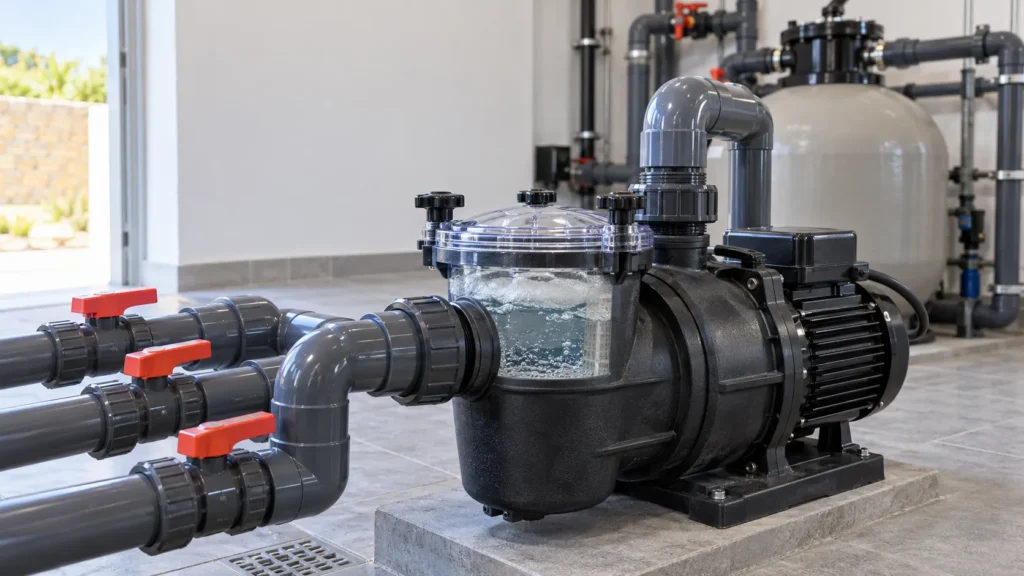
The filter is one of the most important components of any above-ground swimming pool. Its function is to draw in the water, pass it through the filter media and return it to the pool.
To choose the right equipment, you should check the following:
- Total volume of water.
- Pump flow rate.
- Filter capacity.
- Diameter of the connections.
- Distance between the pool and the equipment.
- Length and diameter of the hoses.
- Pressure drops in the circuit.
- Time available to complete the recirculation.
A pump should not be chosen solely on the basis of its power. The pump’s flow rate must be compatible with the filter’s capacity and the pool’s connections.
Compact filtration unit for above-ground swimming pools
When looking to replace a small treatment plant or set up a more comprehensive system, a compact unit that combines a pump and a filter in a single unit can be used.
The Trycompact filtration unit, Ø330 It is specifically designed for above-ground pools, removable pools, small-scale installations and spaces with limited technical access.
This set includes:
- Blown polypropylene filter, Ø330 mm.
- 0.35 CV TRYPOWER pump.
- Pre-filter for larger debris.
- Top-mounted six-way selector valve.
- Pressure gauge.
- Drain valve.
- Fittings and connecting hoses.
- ABS base.
Its nominal flow rate is 6 m³/h. The final selection should be made by checking the volume of the swimming pool, the required turnover time and the pressure drops in the system.
How to calculate the volume of a pop-up swimming pool
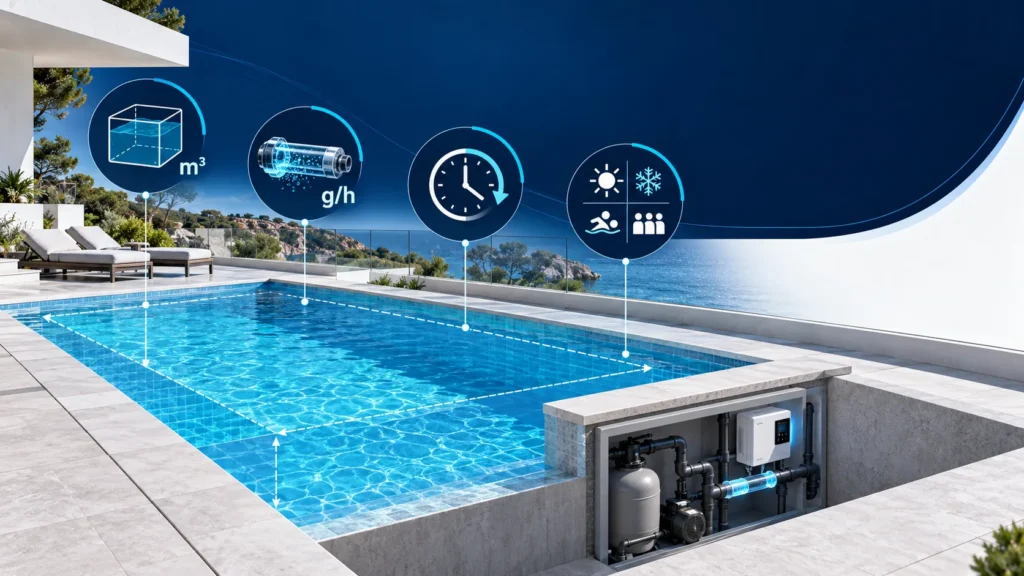
Before choosing a filtration system, you need to have a rough idea of the volume of water in the swimming pool.
Rectangular swimming pool
Multiply:
Length × width × average depth
Example:
A swimming pool 5 metres long, 3 metres wide and 1.20 metres deep contains approximately:
5 × 3 × 1.20 = 18 m³
Circular swimming pool
Multiply:
Radius × radius × 3.14 × depth
The result obtained will be an approximation, as many inflatable pools are not filled to the full height of the sides.
Knowing the volume also enables you to calculate the correct doses of treatment products. The chemical manufacturer’s instructions must always be followed.
Water analysis and treatment
The water should be tested regularly, even if the swimming pool is small. You need to check at least the pH and the disinfectant level.
As a general guide, the CDC recommends a pH level of between 7.0 and 7.8 and a chlorine level of between 1 and 4 ppm, although the instructions for the product being used and the applicable regulations must always be followed. An incorrect pH level can reduce the effectiveness of the disinfectant, cause discomfort and affect the pool’s components.
To carry out these tests, you can use drop kits, test strips or the most advanced analytical equipment.
Floating dispenser for above-ground swimming pools
The floating dispenser holds the treatment tablets and gradually releases the product into the water.
Tablets must not be placed directly on the liner or flexible lining, as a high concentration of the product in a single spot may cause discolouration or damage.
The size of the tablets and the opening of the dispenser must be appropriate for the volume of the swimming pool and in accordance with the treatment manufacturer’s instructions.
At Trypool, the dosing device, test kits and other accessories are included in the cleaning accessories category.
Cleaning a portable swimming pool
Filtration alone cannot remove all the dirt. Leaves may remain on the surface, whilst sand and organic debris eventually settle at the bottom.
A basic cleaning kit might consist of:
- Leaf rake.
- Telescopic pole.
- A brush suitable for use on the cladding.
- Manual pool cleaner.
- Self-floating hose.
- Connection fittings.
- Test kit.
- Floating dispenser.
Trypool offers a specific range of cleaning equipment, including manual pool cleaners, poles, hoses, brushes, leaf skimmers, dosing units and testing kits.
Manual pool cleaner
For above-ground pools with a compatible suction system, a pool cleaner connected via a self-floating hose can be used.
The Trypool flexible pool cleaner It has a Ø38 mm connection and is designed to follow the contours of the pool. Before use, check that the pool connection, the hose and the pump’s suction capacity are compatible.
For flat-bottomed swimming pools, you might also consider a Manual aluminium pool cleaner with a Ø38 mm connection.
Poles, hoses and connectors
The pole allows you to use various accessories without having to get into the pool. It can be attached to a leaf skimmer, a brush or a pool cleaner, provided that the attachment type is compatible.
The telescopic poles allow the length to be adjusted to suit the dimensions of the pool. Trypool’s 4.8-metre combination pole is compatible with accessories that attach using clips or wing nuts.
The diameter of the inlets must also be checked. In above-ground swimming pools, Ø32 and Ø38 mm connections are common, but not all equipment uses the same dimensions.
Do not force the fittings or use adaptors that cause air to enter the system, leaks or an excessive reduction in the water flow.
Recommended maintenance routine
Every day or before a bath
Remove leaves and insects, carry out a visual check of the water condition and ensure that the pump is recirculating the water correctly.
It is also advisable to check that the hoses are not kinked, that there are no leaks, and that the water level is sufficient for the suction system to operate correctly.
Several times a week
Check the pH and the disinfectant, particularly during hot weather or when the pool is in frequent use. Always follow the manufacturer’s instructions for reagents and chemicals.
Weekly
Clean the bottom and walls, check the pump’s pre-filter and check the condition of the filter.
Cartridge filters must be cleaned or replaced in accordance with the manufacturer’s instructions. Filters fitted with a selector valve must be washed and rinsed as required, always ensuring that the pump is switched off before changing the valve position.
Common mistakes with above-ground swimming pools
Using a treatment plant that is too small
A pump with a low flow rate may take too many hours to recirculate the volume of water and may struggle to power a pool cleaner.
Fitting a pump that is too powerful for the filter
A pump that is too large does not always improve filtration. It can exceed the filter’s rated flow rate, increase the pressure and reduce the quality of the process.
Failure to check the diameter of the connections
Differences between Ø32, Ø38, 1½-inch threads and other sizes may prevent direct fitting.
Add the chemical without measuring it
Applying treatment without knowing the condition of the water may lead to overdosing, imbalances or inadequate disinfection.
Connecting several appliances without checking the electrical installation
Pumps, switchboards and treatment systems must be installed with the appropriate electrical protection and in accordance with safety distances.
Can a salt-based chlorination system be installed in a portable swimming pool?
It depends on the swimming pool, the lining, the metal frame, the volume of water and the manufacturer’s instructions.
Before installing a salt chlorinator, you must check that all components are compatible with salt water. You must also select the correct size of cell for the volume of the pool and ensure that the salt concentration remains balanced.
You can find further information in this guide:
Domestic salt-based chlorinators and compatibility with swimming pools
Supplies for inflatable pools at Trypool
Trypool does not currently sell complete above-ground swimming pools, but it does stock professional-grade products that can be used to improve filtration, cleaning and maintenance, provided they are compatible with your installation.
The available solutions include:
- Compact filtration units.
- Cleaning supplies.
- Manual pool cleaners.
- Self-floating hoses.
- Telescopic poles.
- Leaf rake.
- Brushes.
- Dispensers.
- Water analysis equipment.
- Pumps and filtration components.
Compatibility must always be checked, taking into account the volume, connections and specifications of the swimming pool.
 Español
 English (UK)
 Français
 Português