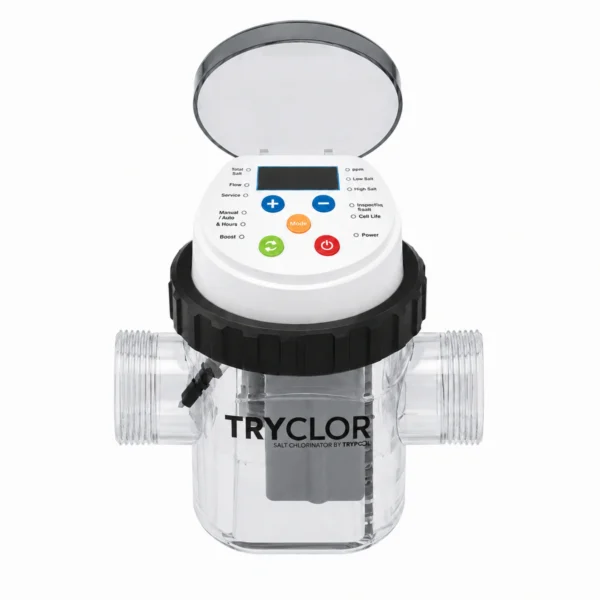
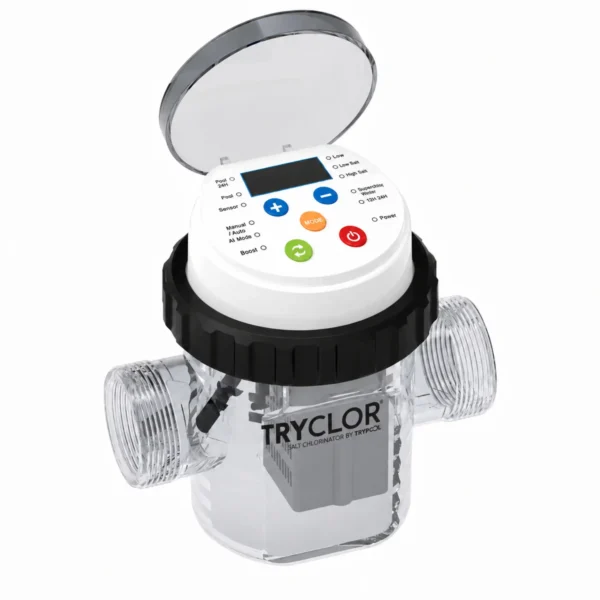
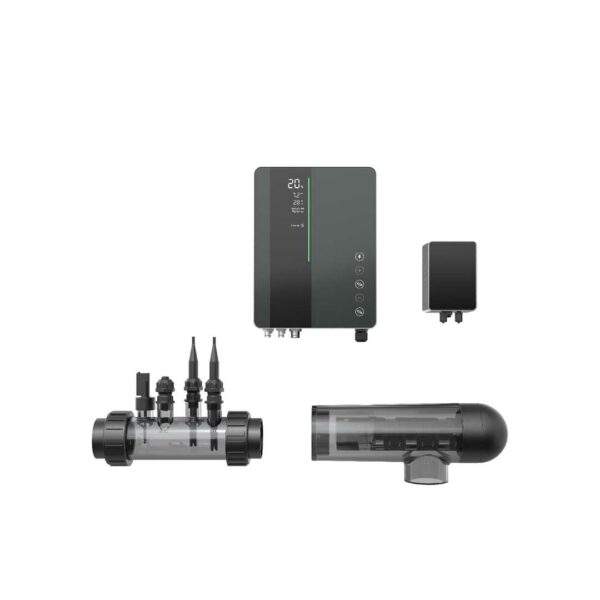
Hidrolife Sugar Valley Salt Chlorinator
Hidrolife salt chlorinators are a range of salt chlorinators designed to automate water disinfection using salt electrolysis.
During operation, salt water passes through the cell, where the disinfectant required to help maintain the pool water in suitable condition is generated. This process takes place whilst the filtration system is running and water is circulating.
The manufacturer officially identifies Hidrolife using SAL part numbers and classifies it as a range of salt chlorinators.
Different models for every installation – Hidrolife salt chlorinator
The Hidrolife range is available in various production levels. The manufacturer’s current documentation lists the following models:
- SAL08NG
- SAL16NG
- SAL22NG
- SAL33NG
- SAL50NG
Trypool’s data sheet is currently designed for production rates of between 16 and 50 grams of chlorine per hour. The specific figures must remain within the selector and the variation table.
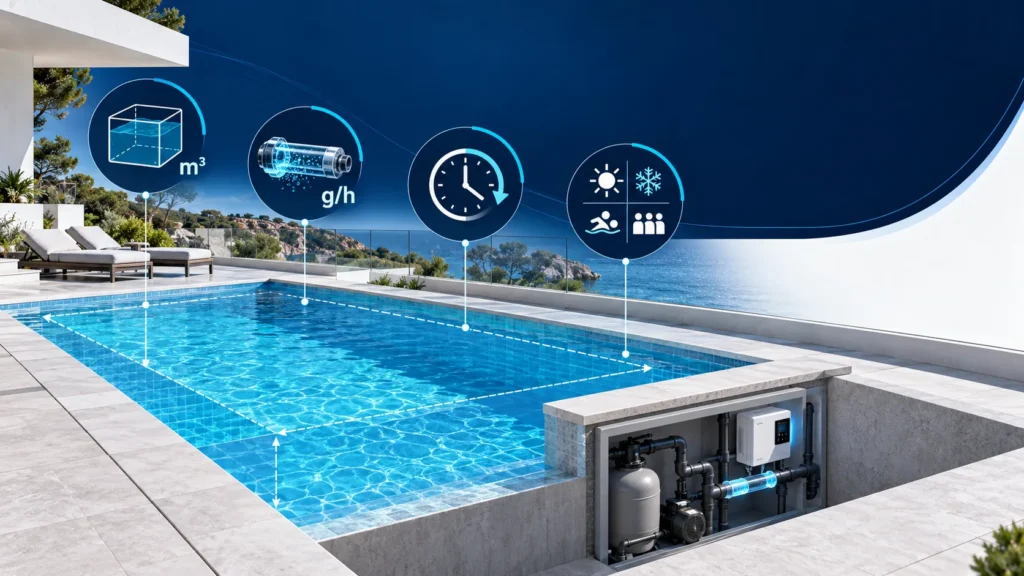
When choosing a model, the following should be taken into account:
- Pool volume.
- Maximum water temperature.
- Sun exposure.
- Usual number of bathers.
- Hours of filtration per day.
- Private or intensive use.
- Existence of a roof.
- Actual demand for disinfectant.
- Specific installation requirements.
It is recommended that you select a model with sufficient capacity to ensure that the cell does not have to operate continuously at maximum output.
Treatment by saline electrolysis
Salt electrolysis produces chlorine from salt dissolved in water.
Once they have carried out their disinfecting function, some of the compounds are reabsorbed into the cycle, reducing the need to add chlorine manually on an ongoing basis.
The salt concentration must be set in accordance with the exact make and model of the equipment. The current Trypool data sheet specifies a concentration of 3 g/l, but this figure must be confirmed for each model before it is presented as a general specification.
Control of the swimming pool from a single device
The Sugar Valley platform enables the centralised management of water treatment and the various components of the plant.
Depending on the selected settings, the system can control:
- Chlorine production.
- Filter pump.
- Variable-speed pumps.
- Lighting.
- Water temperature.
- Automatic pH control.
- Redox or ORP control.
- Measurement of free chlorine.
- Auxiliary outputs.
- Remote access via Wi-Fi or Ethernet.
Hayward confirms that the range’s control unit can manage disinfection, pumps, lighting and temperature, as well as supporting remote connectivity. These functions may depend on the kits and accessories installed.
Automatic pH control – Hidrolife salt chlorinator
Hidrolife can be set up with automatic pH control.
When this option is installed, a sensor measures the water’s pH level and the controller regulates the dosing of the pH adjuster using a compatible pump.
Keeping the pH within the correct range enhances the effectiveness of chlorine and helps to reduce problems such as cloudiness, limescale, corrosion and skin irritation.
It must be confirmed whether the probe, dosing pump and installation fittings are included with each product code.
Redox Control
The Redox control measures the oxidising capacity of the water and allows the chlorine generator’s output to be adjusted to the set value.
This should not be confused with a direct measurement of free chlorine. The redox value may be affected by pH, temperature, stabiliser and other water parameters.
The probe and the Redox module should only be listed as included when they form part of the selected configuration.
Measurement of free chlorine
Some set-ups may include a specific probe for measuring free chlorine.
This function requires the relevant measurement, control and installation components. It should not be listed as standard across the entire range.
Remote connectivity
Depending on the configuration, Hidrolife can be fitted with a Wi-Fi or Ethernet connection to monitor and control certain parameters remotely.
The connectivity module must be confirmed before placing an order, as the manufacturer presents it as an option for expanding the Sugar Valley platform.
Control screen
Trypool’s current product specifications state that the unit features a colour TFT display which can be detached to facilitate installation in an accessible location.
The functions available on the unit can be viewed and configured via the display, depending on the probes and modules installed.
Automation using relays
Trypool states that Hidrolife has seven relays to control the filtration system, lighting and other auxiliary pool components.
The configuration and capacity of each relay must be checked in the technical documentation for the exact model of the equipment.
Recommended applications
The Hidrolife salt-based chlorinator is suitable for:
- Private swimming pools.
- Residential swimming pools.
- Properly sized communal swimming pools.
- New facilities.
- Refurbishment of plant rooms.
- Replacement of old chlorinators.
- Swimming pools with automatic pH control.
- Systems with Redox control.
- Projects managed remotely.
- Facilities that need to control several pieces of equipment from a single unit.
Installation recommendations
The control unit must be installed in a dry, well-ventilated technical area that is protected from water and corrosive vapours.
The cell must be installed in the return circuit to the swimming pool, ensuring that:
- The direction of traffic.
- The mounting position.
- The minimum flow rate.
- Maximum pressure.
- The distances specified by the manufacturer.
- The position of the flow detector.
- The location of the probes.
- The chemical injection points.
The chlorinator must only operate when the filter pump is running and water is circulating.
The plumbing and electrical installation must be carried out or supervised by a qualified professional.



 Español
 English (UK)
 Français
 Português